

How to Choose Guitar Capos
Like the guitars, capos have been around for decades, with many types, brands, and factors involved when choosing one. The tools are valuable when changing the tune of your guitar. As such, you need to learn how to use a capo and not view it as a cheater. Ideally, there should be capo vendors or capo stores with every kind for you to select and buy. However, it is impossible to test every type on your guitar for compatibility or looks. Luckily, they are not expensive, and because they rarely break or wear out, you end up with your mini collection. A capo cannot do everything perfectly to a player, and your favorite will change time and again in your life. If you need a new capo, you can check out thalia guitar capo reviews to make your work of choosing easier.
Below are some tips on how to choose guitar capos:
Consider Size and Weight
In most cases, capos are small and are easy to carry around. However, the different designs mean that there are variations in weight and size. For example, most trigger-style capos are larger than lever-style capos. Some players see them as distractions. Therefore, the small size means it’s as inconspicuous as possible. Also, the extra features added to increase versatility tend to add bulkiness and weight.
Check the Distribution of Pressure Across the Strings
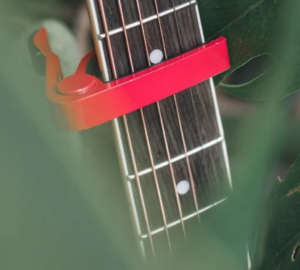 You must be able to adjust overall tension in a capo. However, another factor is the distribution of tension across the strings. Trigger Campos don’t perform well in this regard and apply more pressure on the spring and less at the end. The cradle-style capos score high in this aspect but are looked upon as old-fashioned design. Some manufacturers produce this style due to its benefits. The advantage of cradle style capos is that it has a self-centering cradle that fits behind the middle of the neck when tightened.
Consider the Fit and Radius
The biggest challenge when selecting a capo is that steel-string guitars have curved fingerboards, while the nylon string guitars have flat fingerboards. Most capos are flat or curved, but they vary in fret board curvature, which affects a capos performance. Each guitar manufacture selects a fingerboard radius that suits them. It can be the reason capos work better with some guitars.
Consider the Force
Force determines capo functionality. The elastic and screw clamping mechanisms apply force differently to your strings. You need a capo with just enough and not too much pressure as it can lead to tuning problems. Also, it should handle your string gauges and the height of your strings on the fret board. Spring-powered cops work best for standard gauge strings.